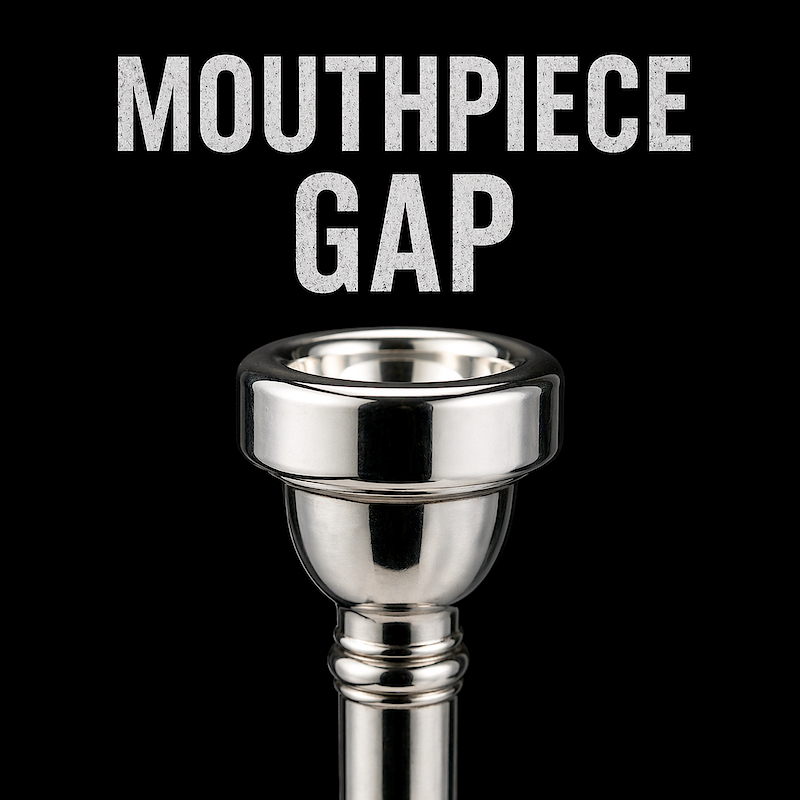
When it comes to building a highly efficient trumpet setup, it is easy to get lost in the weeds of cup diameters, rim contours, and backbore shapes. However, one of the most critical variables is often entirely hidden from view: the mouthpiece gap. Understanding and optimizing this space is about treating the instrument not as a mystery, but as a discipline. By looking at the physics of the gap, we can stop guessing and start manipulating our equipment for maximum endurance and peak acoustic alignment. The gap is the physical distance between the very end of the mouthpiece shank and the beginning of the leadpipe (the venturi) inside the trumpet's receiver. When a mouthpiece is inserted, it doesn't usually sit perfectly flush against the leadpipe. That resulting void creates a sudden, microscopic expansion and contraction in the instrument's bore. Far from being a manufacturing defect, this void acts as a vital acoustic choke point. It dictates how the sound wave transitions from the mouthpiece into the horn, directly influencing the instrument's resistance, slotting, and intonation. To understand why the gap matters, we have to look at how a trumpet actually produces sound. A trumpet relies on standing waves and the alignment of harmonic nodes. When the air and sound energy travel past the throat of the mouthpiece and out the backbore, they hit the gap. This perturbation in the bore disrupts the wave. We are currently in a golden age of brass acoustics, moving far beyond the old trial-and-error methods. Just as an audio engineer uses precise EQ plugins and spectral analysis to shape a mastering track, modern acoustic technicians use pulse reflectometry and impedance mapping software to visualize exactly what a trumpet is doing. By sending a sound pulse through the assembled horn and mapping the reflections, these tools generate an acoustic impedance curve. This allows players to dial in exact resistance levels for specific gig demands. You can physically see the acoustic disruption caused by the gap and calculate exactly how many thousandths of an inch are required to bring the upper register perfectly in tune with the fundamental. Different musical environments require entirely different acoustic responses. Here is how the gap is typically optimized for the two primary realms of playing: The orchestral player needs a massive, stable core that can project through a 100-piece symphony without the tone becoming thin or shrill. The commercial or lead player requires immediate transient response, maximum efficiency, and effortless access to the extreme upper register. You cannot build a towering endurance foundation if your equipment is constantly fighting your face. To truly manipulate the gap, modular equipment is essential. Modern manufacturers (such as Reeves, Warburton, and Pickett) offer highly refined modular solutions: New gear only magnifies your daily habits, but playing with a misaligned gap is like driving a sports car with the parking brake on. By utilizing modular components to optimize this acoustic choke point, you allow the instrument to handle the heavy lifting of intonation and resistance, saving your embochure for the music itself.The Acoustic Choke Point: Demystifying the Trumpet Mouthpiece Gap
What is the Mouthpiece Gap?
The Physics of the Gap
Acoustic Mapping: Visualizing the Resistance
Optimized Setups: Dialing in the Demands
1. The Symphonic Engine (Classical Setup)
2. The Lead Scalpel (Commercial Setup)
Using Modular Equipment for Endurance
The Bottom Line