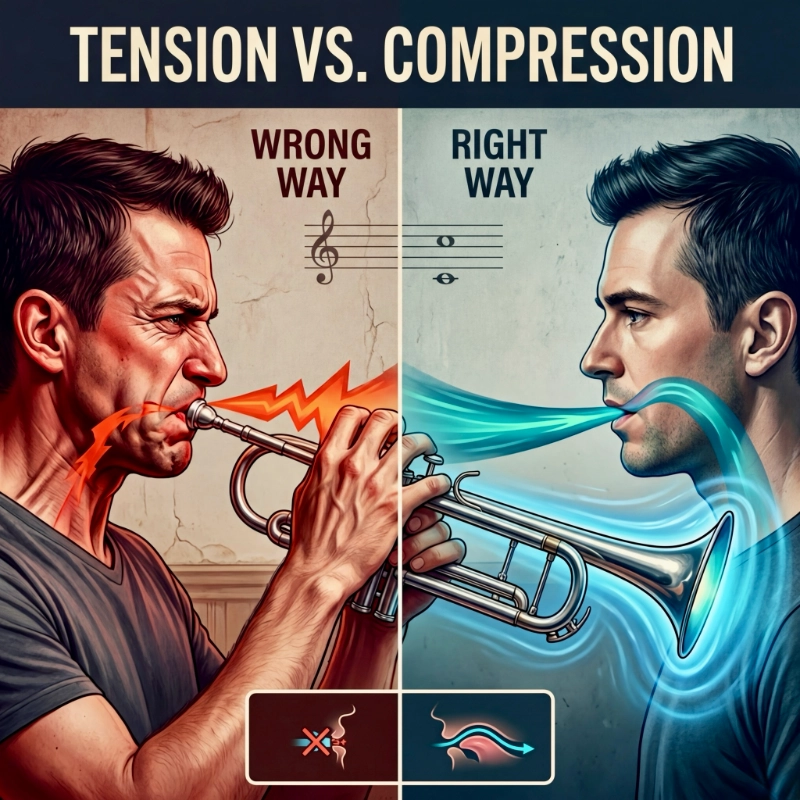
If there is one universal wall that every trumpet player hits—whether you are a high school student trying to squeak out a G above the staff or a seasoned pro trying to survive the third hour of a grueling gig—it is the upper register. For decades, the trumpet world has been plagued by vague advice. "Support more." "Use more air." "Tighten your corners." While well-intentioned, these phrases often lead players down a dangerous path. They treat the instrument like a mystery to be conquered through sheer willpower rather than a discipline governed by applied acoustics and physical mechanics. The difference between soaring over a big band with a brilliant, resonant lead sound and completely destroying your chops before the first set ends comes down to two opposing physical forces: Tension and Compression. Understanding the subtle, make-or-break differences between these two concepts is the key to unlocking your symphonic engine and building true lead scalpel endurance. Let's break down the realities of the face, the air, and the horn. To understand why so many players fall into the trap of tension, we have to look at human psychology and biology. When we encounter a difficult physical task—like lifting a heavy box—our natural instinct is to recruit auxiliary muscles. We clench our jaws, tighten our necks, and hold our breath to stabilize our core. This biological response is called the Valsalva maneuver. When you see a high note approaching on the page, your brain perceives a difficult physical task. If your fundamentals aren't rock solid, your body automatically triggers that same weightlifting response. The Grip: You squeeze the horn with your hands, pulling the mouthpiece into your face to force the notes out. The Squeeze: You pinch the red of your lips together, crushing the aperture (the opening where the air escapes) to make it smaller. The Choke: Your neck veins bulge, your throat closes up, and your shoulders rise. The Pinched Sound: Because the aperture is crushed and the throat is tight, the sound becomes thin, laser-like, and brittle. It lacks core and resonance. The cruel irony of tension is that it feels like you are doing the right thing. You are sweating, your face is working hard, and you are putting in a massive amount of effort. You might even squeeze out that High C. But what is the cost? Tension is a localized, destructive force. Pinning the mouthpiece against your embouchure cuts off blood flow, leading to rapid swelling, bruising, and a completely blown-out face. If you rely on tension, your recovery time is measured in days, not minutes. You are literally fighting your own body—and the trumpet always wins. If tension is the act of muscular gripping and brute force, compression is the act of efficient, aerodynamic pressure. Think of a garden hose. If you want the water to shoot further across the yard, you don't squeeze the water tank tighter. Instead, you put your thumb over the nozzle. By decreasing the size of the exit point while maintaining the same pressure from the source, the water naturally accelerates and shoots further. This is the exact acoustic principle required to play the trumpet efficiently. High notes do not require more air volume—they require faster air speed. Compression is the disciplined coordination of your air supply, your tongue arch, and your embouchure to create high-velocity air without muscular strain. Compression begins in the core, but it is not about bearing down as if you are doing a sit-up. It is about an active, engaged release of air. Your abdominal muscles, intercostals, and diaphragm work in tandem to create a steady, pressurized column of air. This pressure must be constant. If the air column sags, your face has to work twice as hard to keep the pitch up—immediately triggering tension. This is the unsung hero of the upper register. Say the syllable "Ah." Notice how your tongue sits flat and low. When you channel your air stream through that smaller, elevated channel, the air speed increases exponentially before it even reaches your lips. By relying on the tongue arch to generate air speed, you remove the burden from your fragile lip muscles. In a compression-based system, the embouchure is not the engine—it is simply the gasket. The corners of the mouth remain firm and anchored, pointing slightly downward. The center (the aperture) stays relaxed enough to vibrate freely. Instead of pinching the lips together, you roll them slightly inward, creating a thicker cushion that can withstand fast air. When these three elements align, you achieve true compression. The air moves incredibly fast, the lips vibrate efficiently, and the sound becomes massive, broad, and resonant. You are no longer forcing the horn—you are setting the conditions for it to respond. The line between tension and compression is razor thin. Here’s how to tell where you stand: Tension: You inhale, lock your throat, hold the air, then force it out (glottal stop). Compression: The breath turns around seamlessly—air is always moving. Tension: Thin, bright, pinched, eventually chokes off. Compression: Full, resonant, consistent core—even at high C. Tension: Swelling, numbness, red ring, jaw/neck pain, long recovery. Compression: Healthy fatigue, but lips remain responsive. You can play again soon. Tension is learned—which means it can be unlearned. Hold your hand in front of your face: Blow with "Ah" → warm, slow air. Switch to "Eee" → cold, fast, focused air. No face tension required. That’s compression. Play a G. Bend it down to F# and back without changing fingering. Forces relaxed aperture. Eliminates mouthpiece pressure. Builds control through air—not force. Play high notes at piano. If it doesn’t speak, don’t push. Adjust air speed and tongue arch instead. Compression thrives on finesse, not brute force. Your routine is your programming. The Ultimate Warm Up → trains response to air, not tension. The Ultimate Technical Study → builds efficiency. The Ultimate Wedding Book → tests endurance under fire. When fatigue hits, your habits take over. Train the right ones. The shift from tension to compression is not instant. It requires patience, honesty, and the willingness to rebuild. Stop treating the upper register as a test of strength. Release the grip. Let physics do the heavy lifting. When everything aligns, the trumpet stops being a fight—and becomes what it was always meant to be: A resonant, effortless extension of your voice.The Illusion of Effort: Why Tension Feels "Right"
The Anatomy of a Tension-Based Player:
The Science of Compression: The Engine of the Upper Register
The Three Pillars of True Compression
1. The Core Support (The Water Tank)
2. The Tongue Arch (The Thumb on the Hose)
Now say "Eee." Notice how the middle and back of your tongue rise toward the roof of your mouth, shrinking your oral cavity.3. The Embouchure (The Gasket)
The Subtle Differences: How to Self-Diagnose
1. The "Air Block" Test
2. Tone Quality Above the Staff
3. The Physical Aftermath
Reprogramming Your Approach
Master the Wind Pattern
Incorporate Lip Bends
Practice Soft High Notes
The Role of Your Daily Routine
Conclusion: The Trumpet is a Discipline
It is a test of efficiency.
Arch the tongue.
Accelerate the air.Now, go practice.